





Międzynarodowa Interdyscyplinarna Konferencja Naukowa: #Uncancel culture | 4-6.12.2025
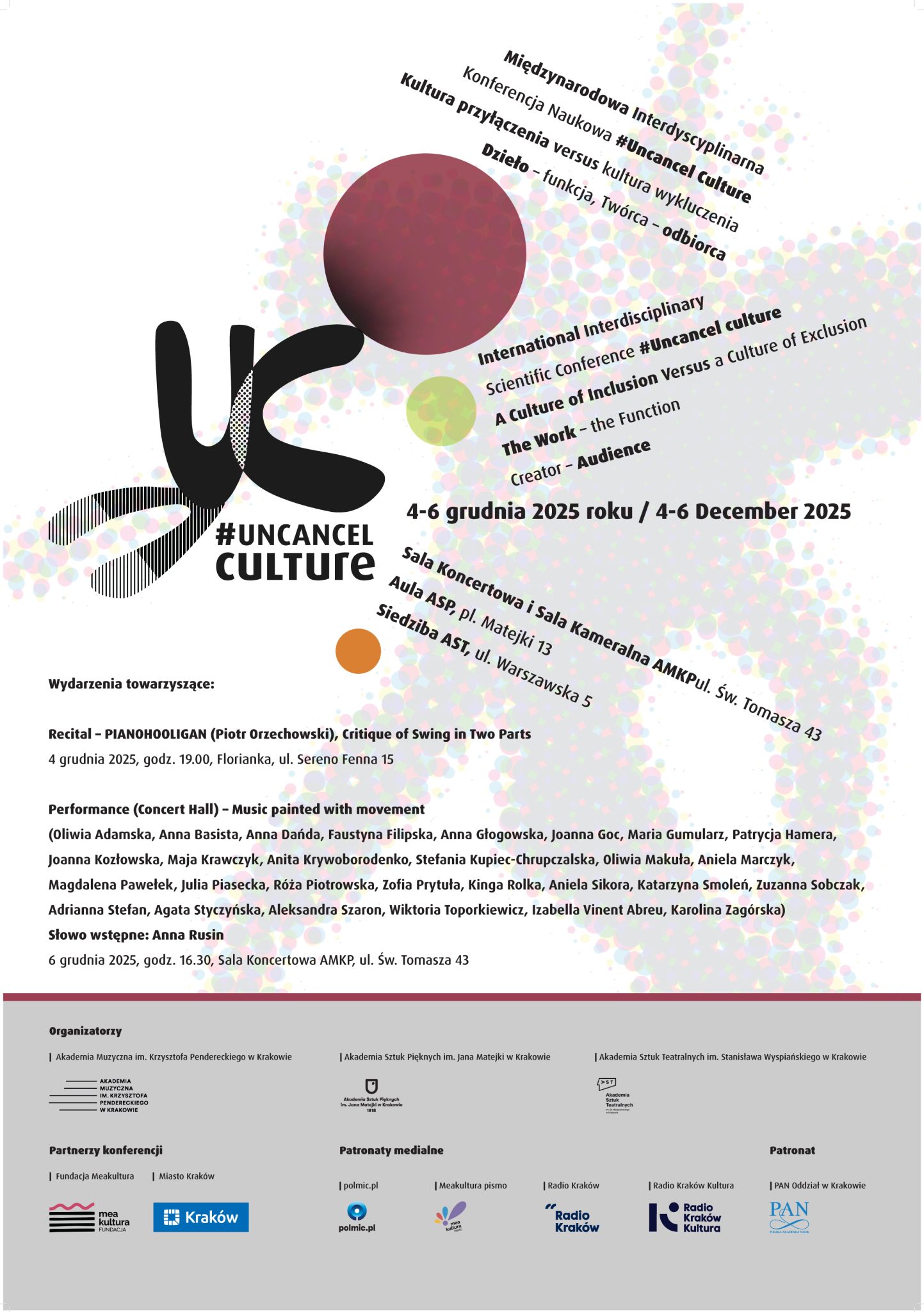
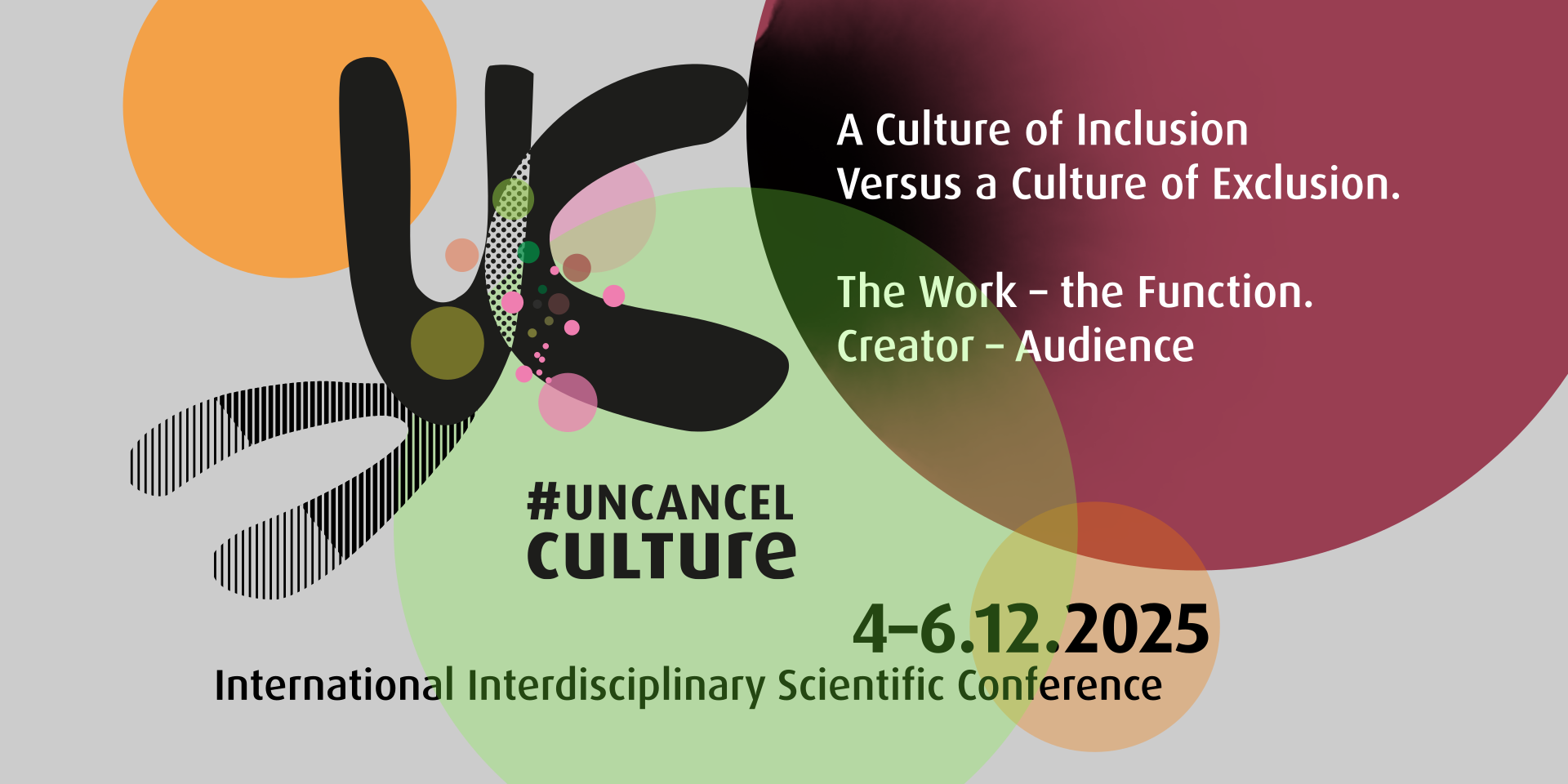
#Uncancel culture
Kultura przyłączenia versus kultura wykluczenia.
Dzieło – funkcja. Twórca – odbiorca
Międzynarodowa Interdyscyplinarna Konferencja Naukowa
4-6 grudnia 2025 roku
Serdecznie zapraszamy do udziału w Międzynarodowej Interdyscyplinarnej Konferencji Naukowej, zrzeszającej środowiska artystyczne z wielu dziedzin sztuki. Problem postawiony w tytule Konferencji stanowić ma impuls do podjęcia możliwie szerokiej dyskusji z pojęciem od pewnego czasu obecnym w humanistyce, jakim jest kultura wykluczenia czy unieważniania (cancel culture). Plasujące się na biegunie przeciwstawnym pojęcie przyłączenia można rozumieć jako postawę otwartości i akceptacji zjawisk artystycznych, niezależnie od upodobań estetycznych, poziomu wykształcenia czy przekonań.
Zachęcamy do podjęcia refleksji nad dziełem sztuki i jego funkcją w kulturze oraz nad osobą twórcy w konfrontacji ze współczesnym odbiorcą, zwracając szczególną uwagę na aspekty zjawisk przyłączania i wykluczania w sztuce, takie jak:
- historyczny – przykłady przyłączania i wykluczania w dziejach sztuki;
- teoretyczny – dotyczący technik kompozytorskich, plastycznych i teatralnych, tworzywa twórczego, form, gatunków;
- estetyczny – dotyczący przemian stylistycznych, nurtów i tendencji i obowiązujących kryteriów estetycznych;
- ultrawspółczesny – uwzględniający współczesne tendencje „hiperprzyłączeniowe” w sztuce: łączenie różnych stylów i mediów, mieszanie różnych form wyrazu, angażowanie różnych zmysłów, łączenie sztuki z przesłaniem ideowym i technologią, oraz tworzenie doświadczeń w pełni angażujących odbiorców (transawangardowość, polistylistylizm, polisensoryczność, aktywizm, obiektofoniczność, immersyjność, wirtualność, audialność i transaudialność itp.);
- wartościujący – preferencji odbiorców, ale także artystów i wykonawców;
- tożsamościowy – kwestie samowykluczenia, wyobcowania, poczucia braku przynależności lub tożsamości artystycznej.
Ponieważ semantyczność muzyki pozostaje nieoczywista i niedosłowna, chętnie wchodzi ona w relacje z innymi artefaktami kultury: tekstami literackimi, teatrem, filmem, sztukami wizualnymi, performancem, a także z filozofią i estetyką sztuki. Muzyka jest zatem szczególnie predystynowana do roli dziedziny pośredniczącej w relacjach między sztukami, do bycia centrum procesów interdyscyplinarnego przyłączania.
Zachęcamy badaczy do przedstawienia referatów w szerokim kontekście interdyscyplinarnym, łączącym dziedziny: teorii muzyki / muzykologii, medioznawstwa, filmoznawstwa, performatyki, kulturoznawstwa, literaturoznawstwa, socjologii, sztuk wizualnych i sztuk teatralnych. Językiem konferencji będzie język angielski.
Zgłoszenia
Zapraszamy do nadsyłania abstraktów dla 20-minutowych prezentacji w języku angielskim, na adres uncancel@amuz.krakow.pl do 20 CZERWCA 2025 r. Prosimy o załączenie dwóch plików w formacie Word (.docx): Wszystkie abstrakty zostaną poddane procesowi weryfikacji przez komitet programowy, a autorzy będą powiadomieni o ich przyjęciu do 1 LIPCA 2025 roku. Decyzje dotyczące Państwa propozycji zostaną przekazane pocztą elektroniczną, podobnie jak informacje dotyczące rejestracji. Wybrane referaty znajdą się w planowanej publikacji pokonferencyjnej. Opłata konferencyjna Akademicy i uczestnicy bez afiliacji: 130 EUR (pełna kwota), Opłaty należy dokonać do 15 lipca 2025 r.
1. propozycję zawierającą jedynie tytuł referatu i abstrakt (300 słów). Plik ten nie powinien zawierać żadnych informacji identyfikujących.
2. krótki dokument zawierający następujące informacje: imię i nazwisko autora, afiliację, krótki biogram (100 słów), tytuł referatu, słowa kluczowe i wszelkie potrzeby z zakresu sprzętu audiowizualnego.
Doktoranci: 65 EUR (50% zniżki)
Opłata nie obejmuje kosztów podróży i zakwaterowania. Organizatorzy oferują pomoc w rezerwacji noclegów w Krakowie w korzystnych cenach. Uczestnicy reprezentujący instytucje organizujące będą upoważnieni do 80% zniżki opłaty konferencyjnej.
Komitet programowy
dr Iwona Sowińska-Zając (AMKP, kierownik projektu)
dr hab. Małgorzata Janicka-Słysz, prof. AMKP
dr hab. Agnieszka Draus, prof. AMKP
dr Andrzej Mądro (AMKP)
dr Marcin Strzelecki (AMKP)
dr Maria Wilczek-Krupa (AMKP)
dr hab. Agata Kwiatkowska-Lubańska (ASP)
dr hab. Olga Katafiasz (AST)
Organizatorzy
Akademia Muzyczna im. Krzysztofa Pendereckiego w Krakowie
Akademia Sztuk Pięknych im. Jana Matejki w Krakowie
Akademia Sztuk Teatralnych im. Stanisława Wyspiańskiego w Krakowie
Program konferencji
Do pobrania:
Uncancel culture PROGRAMME.pdf
4 December, Thursday
8:00-9:00 Registration
9:00 Welcome (Concert Hall)
I Session A, Concert Hall, 9:30-11:00
Inclusion vs Exclusion
Chair: Małgorzata Janicka-Słysz
09:30 Owen Belcher (USA), Inclusion and the Culture Industry
10:00 Agnieszka Draus (Poland), Inclusions doomed to exclusion
10:30 AbdulQuddus Mohammed / Venous Moslem Shojaei (UAE), AI and Creativity in the UAE: How Technology Supports an Inclusive and Inspiring Artistic Future
I Session B, Chamber Hall, 9:30-11:00
Music Theory and Culture
Chair: Andrzej Mądro
09:30 Marcin Strzelecki (Poland), The Materiality of Music and Its Role in Shaping Musical Culture
10:00 Lucia Reiprich Maloveská (Czech Republic), Between sanctity of score and individual experiences. Dilemmas and roles of contemporary music theory
10:30 Mateusz Borkowski (Poland), Broadway, Race, and Cancel Culture
11:00-11:30 Coffee break
II Session A, Concert Hall, 11:30-13:00
Aspects of Performance
Chair: Marcin Strzelecki
11:30 Chris David Westover-Muñoz (USA), “To be (wa)or not to be?” The conductor/curator in confrontation with genre
12:00 Chae-Lin Kim (Austria), “Deaf Performance Now!”: Voices from the Deaf Community
12:30 Renate Bräuninger (Germany), Musique dansante uncancelled
II Session B, Chamber Hall, 11:30-13:00
Composers
Chair: Agnieszka Draus
11:30 Božena Čiurlionienė (Lithuania), #(Un)canceled Artist: Mikalojus Konstantinas Čiurlionis
12:00 Olha Myronenko-Mikheishyna (Ukraine), Musical Time in Witold Lutosławski’s Works Through the Prism of Audience Perception
12:30 Anna Rusin (Poland), When Two Worlds Collide: The Musical Laughter Facing The Nazi Camps
13:00-15:00 Lunch
Keynote lecture I, Concert Hall, 15:00-16:15
Stefan Lorenz Sorgner, Uncancelling Cancel Culture
Introduction: Iwona Sowińska-Zając
16:15-16:45 Coffee break
III Session A, Concert Hall, 16:45-18:15
Inclusion vs Exclusion
Chair: Iwona Sowińska-Zając
16:45 Ewa Czachorowska-Zygor (Poland), The individual versus the system. Cinema of moral concern and its music
17:15 Eduardo Solá Chagas Lima (Canada), #Uncancel Music Education: Integrating Autobiographical Theory in Kodály Frameworks
17:45 Jerzy Luty (Poland), Canceling by Cognition? How Knowledge, Reputation, and Morality Shape Aesthetic Inclusion and Exclusion Across Cultures
III Session B, Chamber Hall, 16:45-18:15
Sociology, Politics, Law
Chair: Marcin Strzelecki
16:45 Zbigniew Pinkalski (Poland), Can provisions of copyright law cancel the cancel culture?
17:15 Barbara Jabłońska (Poland), Exclusion in Communication on Musical Topics from the Perspective of Critical Discourse Analysis
19:00 Concert, Florianka Recital Hall
Piotr Orzechowski. Pianohooligan – Critique of Swing in Two Parts
5 December, Friday
9:00-10:00 Registration
I Session A, Concert Hall, 10:00-11:30
Contemporary Music
Chair: Agnieszka Draus
10:00 Alexandra Magazin (Romania), Marcel Mihalovici: From Exclusion to Universal Expression – A Case Study in 20th Century Artistic Identity
10:30 Zuzanna Daniec (Poland), Disappointment Category and Devaluation of Status. “Chain of Undermining” in Lachenmann and Peszat’s Work
11:00 Klaudia Gawronek (Poland), Polish Folklore in View of the 20th Century Cultural Offensive
I Session B, Chamber Hall, 10:00-11:30
Opera and Dance
Chair: Małgorzata Janicka-Słysz
10:00 Anna Dańda (Poland), Émile Jaques-Dalcroze (1865-1950). A portrait sketch with the art of dance in the background
10:30 Mariachiara Grilli (Italy), Inclusion as symbiosis in LIFE (1999), an Opera by Ryuichi Sakamoto
11:00 Yurim Ko (Austria), Rethinking Turandot: Orientalism, Confucian Virtue, and the Myth of Cultural Enlightenment
11:30-12:00 Coffee break
Keynote lecture II, Concert Hall, 12:00-13:15
Mark Andre, „About music by/of disappearing: „…selig ist…“ for piano and electronics, „…selig sind…“ for clarinet and electronics
Introduction: Michael Heinemann
13:15-14:45 Lunch
II Session A, Concert Hall, 14:45-16:15
Cultural memory
Chair: Iwona Sowińska-Zając
14:45 Christina Guillaumier (UK), Marion Scott and the Politics of Cultural Memory: Reclaiming a Marginalised Musical Life
15:15 Krzysztof Bielawski / Mariusz Koluch (Poland), Eleusis: Unspeakable – a scientific-artistic project
II Session B, Chamber Hall, 14:45-16:15
Background Diversity
Chair: Marcin Strzelecki
14:45 Nolan Miranda (USA) – online, Three Participatory and Collaborative Improvisation Environments: Reflections on Composing for Performers with Diverse Musical Backgrounds
15:15 Geneviève Bélanger-Nantel (Canada) Speaking from the Margins: Cancelled Artists and the Aftermath of #MeToo in Quebec
Moving to AST (National Academy of Theatre Arts in Krakow)
III Session, AST, Experimental Scene, 5 Warszawska Street, 16:45-18:15
Theatre, Film and Music Theory
Chair: Marta Bryś
16:45 Olga Katafiasz (Poland), The New Map with the Augmentation of the Indies
17:15 Iwona Grodź (Poland), Musicians and music in Polish cinema. Strategies of inclusion and exclusion
17:45 Tomasz Kienik (Poland), CANcelled and UNcancelled – Prominent Music Theorists and Musicologists as Composers – a Reconnaissance
Performance, AST, Classical Scene, 5 Warszawska Street, 19:00
Songs of the Polish Bakers [Pieśni piekarzy polskich] by Mariusz Gołosz, dir. Klaudia Gębska
6 December, Saturday
Curator-guided tour of the exhibition, ASP, Auditorium, 13 Jan Matejko Square, 10:00-10:45
10:45-11:00 Coffee break
Keynote lecture III, ASP, Auditorium, 11:00-12:00
Magdalena Ujma-Gawlik, Is Culture of Support and Care Possible?
Introduction: Agata Kwiatkowska-Lubańska
12:00-14:30 Lunch
Moving to AMKP
Panel discussion & Conference closing, AMKP, Chamber Hall, 14:30-16:00
prof. dr hab. Mariusz Sielski (AMKP Rector), dr hab. Małgorzata Janicka-Słysz, prof. AMKP, dr Maria Wilczek-Krupa, dr hab. Grzegorz Mielczarek, prof. AST (AST Rector), prof. dr hab. Dorota Segda, dr hab. Olga Katafiasz, prof. AST, prof. dr hab. Andrzej Bednarczyk (ASP Rector), dr hab. Agata Kwiatkowska-Lubańska, dr hab. Robert Sowa
Moderators: Agnieszka Draus, Iwona Sowińska-Zając, Andrzej Mądro
Performance, AMKP, Concert Hall, 16:30
Music painted with movement
Oliwia Adamska, Anna Basista, Anna Dańda, Faustyna Filipska, Anna Głogowska, Joanna Goc, Maria Gumularz, Patrycja Hamera, Joanna Kozłowska, Maja Krawczyk, Anita Krywoborodenko, Stefania Kupiec-Chrupczalska, Oliwia Makuła, Aniela Marczyk, Magdalena Pawełek, Julia Piasecka, Róża Piotrowska, Zofia Prytuła, Kinga Rolka, Aniela Sikora, Katarzyna Smoleń, Zuzanna Sobczak, Adrianna Stefan, Agata Styczyńska, Aleksandra Szaron, Wiktoria Toporkiewicz, Izabella Vinent Abreu, Karolina Zagórska
Introduction: Anna Rusin
Partnerzy:


Patronat medialny:




Biznes i Nauka w Krakowie – strona internetowa
Biznes i Nauka w Krakowie na Facebooku
Foldery promocyjne Miasta Krakowa
Kraków – ze względu na siłę demograficzną, ekonomiczną, społeczną i naukowo – kulturową – jest drugim miastem Polski. Posiada unikalne walory, na których opiera rozwój gospodarczy oraz wzrost jakości życia. Dysponuje wysokiej jakości kapitałem ludzkim, jest miastem świadomego wyboru miejsca zamieszkania, pracy, nauki, spędzania wolnego czasu dla ludzi wykształconych i kreatywnych. Priorytetem jest zrównoważony rozwój i możliwość sprostania konkretnym wyzwaniom przy umiejętnym wykorzystaniu własnych zasobów.
Ośrodek akademicki, z działającym od 650 lat Uniwersytetem na czele, jest trwale zespolony z miastem i w unikalny sposób buduje niepowtarzalny zasób wiedzy. Jest kluczem do konkurencyjności i innowacyjności nie tylko Krakowa, ale także całego regionu. Rozwijająca się intensywnie gospodarka oparta na wiedzy to zupełnie nowy proces w życiu gospodarczym Miasta, który włącza go w obieg nowoczesnej ekonomii świata.
Nadrzędnym celem jest, by Kraków był nie tylko miastem nowoczesnym, ale i dumnym z historycznego dziedzictwa. By był otwartą, bogatą, przyjazną i bezpieczną metropolią, tętniącą kulturą. Inteligentne zarządzanie i wzmacnianie sfery nowoczesnych usług oraz sektora badawczo-rozwojowego jest fundamentem rozwoju Krakowa – miasta, w którym stawia się na innowacyjność i efektywną współpracę nauki i biznesu.
Zapraszamy do odwiedzenia naszej strony internetowej i zapoznania się możliwościami, jakie oferuje magiczny Kraków – zakorzeniony w tradycji, uwrażliwiony na codzienność i otwarty na rozwój: www.dlabiznesu.krakow.pl.